

Antonietta Knetge Attends Specialised Training at University Claude Bernard
Antonietta Knetge Attends Specialised Training at University Claude Bernard
A member of our lab, PhD researcher Antonietta Knetge, has recently returned from two weeks of training with Prof. Bernard Gomez at the University Claude Bernard 1 in Lyon, France.
From the training, she learned cuticle preparation techniques on Cretaceous fossil material. The training covered: the extraction of plant material from water-soluble sediment, sorting of dried plant material by taxa, chemical preparation, and dissection of foliar cuticle for light microscopy and SEM analysis.
All materials prepared were from Cretaceous localities in France with a principal focus on gymnosperms and particularly the conifer Frenelopsis, to determine its habit and ecology.


'Carbon Dioxide Assimilation in Plants: from Genome to Biome' - Gordon's Research Conference 2023
Two of our lab members Prof. Jennifer McElwain and Dr. Christos Chondrogiannis had the privilege of attending a Gordons Research Conference (GRC) on the topic of photosynthesis from 7th – 12th of May 2023. The conference took place at Renaissance Tuscany Il Ciocco Resort & Spa, a tranquil estate nestled in the lush hilltops of Tuscany, Italy.
The conference, titled “CO2 Assimilation in Plants from Genome to Biome”, brought together researchers from leading labs, from PhDs making the first steps in their career to famous, well-established researchers of photosynthetic studies. The aim of the conference was to advance frontiers in the field of photosynthesis by showcasing cutting edge and unpublished research on a wide suite of plants, from rare species to widely cultivated crops. The rigorous discussions that happened between researchers informally were a highlight of the event. Fruitful discussions that stretched over lunch and well into the evening led to the genesis of new ideas and future collaborations.
Prof. Jennifer McElwain presented the final talk of the conference, titled ‘Reconstructing Terrestrial Ecosystem Function in Deep Time using Paleo-Plant Traits and Paleo-Ecosystem Modelling’. McElwain discussed the importance of accurate estimates and reconstructions of atmospheric CO2 through deep time. She also presented her idea of paleo-traits, the application of modern plant functional trait ecology within palaeobotany, which will enable reconstruction of plant activity in paleo-environments.
Dr. Christos Chondrogiannis presented a poster titled ‘Photosynthetic rate as a focal trait to assess plant weathering rate across evolutionary groups’, detailing how his chamber experiments aim to establish a correlation between photosynthesis and weathering rates and uncover information on how these processes interact. Chondrogiannis also had the pleasure of attending a workshop on the 6th of May, titled “Photosynthetic efficiency in a changing environment.”


EGU23 General Assembly - Vienna 2023
The EGU23 General Assembly was held in Vienna from 14-19 April 2023. Located on an island in the magical Danube, the warm and welcoming Austria Center Vienna welcomed the 15,453 attendees from 107 countries around the world. The conference was a great success, as 16,357 presentations were given in 938 different sessions.
TERRAFORM was represented by Christos Chondrogiannis, William Matthaeus and Richard Nair.
Christos Chondrogiannis gave an oral presentation in the session “Co-evolution of life and the Earth, and major transitions in Earth’s biosphere and environment” titled “TERRAFORM: Trait ecology and Biogeochemical cycles in deep time”. He presented the goals of TERRAFORM project, how plants affect the biogeochemical cycles, and how modern trait ecology can be implemented in the fossil record to inform us about plant activity in the deep time.
William Matthaeus had a poster titled “Moisture seasonality as a differential driver of modelled forest distribution during the Pennsylvanian” presenting part of his recent work. Specifically, by using the Paleo-BGC ecosystem process model, he showed simulation evidence supporting the long-held inference that moisture seasonality explains the spatial distribution of the major plant types of the late Paleozoic ice age.
Finally, Richard Nair, presented a poster titled “Day-night root dynamics change through the growing season”, where he showed shifts in the diurnal pattern of root growth during the growing season. Richard, was also a co-convener at the session titled “Vegetation functional responses to global change across multiple methods and scales” and presented during the townhall meeting for the CLEANFOREST EU COST action.
Many participants were interested in the work of the attending TERRAFORM members, with a high level of engagement around the presentations. In addition, the members of the group had the opportunity to attend presentations related to their research interests. At the same time, fruitful discussions and acquaintances with emerging and distinguished scientists took place.


The 33rd Environmental Sciences Association of Ireland
The 33rd Environmental Sciences Association of Ireland


The 66th Irish Geological Research Meeting - Belfast 2023
The 66th Irish Geological Research Meeting
The 66th Irish Geological Research Meeting (IGRM) took place from 3 – 5 March 2023. The event was hosted at the Ulster Museum at the Botanic Gardens in Belfast. Over 150 individuals attended the conference. Keynote talks were featured by Professor Andy Gale who discussed the reconstruction of a Cretaceous greenhouse world and Professor Adrian Jones who discussed his work on diamonds and the carbon cycle.
Terraform’s master’s student, Ms. Bea Jackson gave a presentation on her work on estimating Devonian paleo-atmospheric CO2 concentrations using fossil plant traits. Team members, Dr William J. Matthaeus, Dr Christos Chondrogiannis, Ms Antonietta Knetge and Ms Catarina Barbosa also attended to present a joint team poster on how the Terraform project will employ modern trait ecology to expand the horizons of paleo-botany and further uncover the science behind biogeochemical cycles in deep time.
The programme for the 66th Irish Geological Research Meeting is available here.
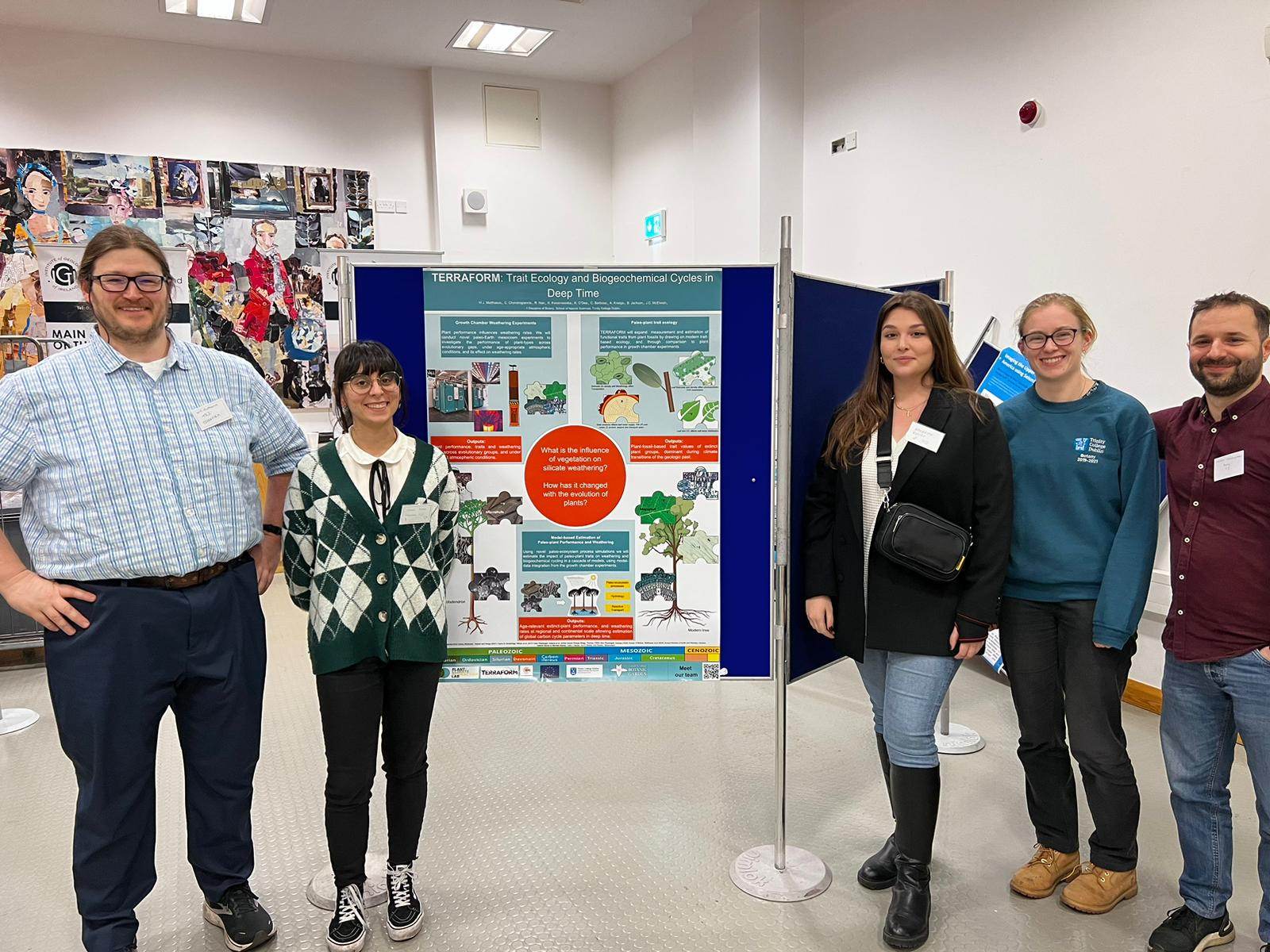


The 12th annual TCD Botany-Zoology Post-Graduate Symposium
The 12th annual TCD Botany-Zoology Post-Graduate Symposium
The 12th annual TCD Botany-Zoology Post-Graduate Symposium took place from 2-3 March 2023. The two-day symposium gives post-graduate students within the departments of Botany and Zoology the opportunity to showcase their work. It’s an excellent opportunity for staff and students from the TCD School of Natural Sciences to engage with the varied array of research that takes place within the two departments.
22 post-graduates from across the two departments presented their research projects. The topics spanned from natural capital accounting to visual processing in animals, heatwave effects on parasites to the understanding of the role of urban wild spaces in maintaining mental health. Ms. Bea Jackson of the Plant-Climate lab was an organizer of the event. Bea also presented her work on estimating Devonian paleo-atmospheric CO2 concentrations using fossil plant traits. Ms. Antonietta Knetge gave a talk on the use of traits to uncover abiotic stress in Mesozoic flora. Congratulations to Mr. Ian Clancy of the Botany Department for winning the overall best talk for his presentation on understanding the carbon sequestering potential of Irish grasslands.
We were delighted to host two excellent keynote speakers for the event. Dr Sandy Hetherington, a paleo-botanist, travelled from the University of Edinburgh to give an engaging talk on the origins of plant complexity. Dr Aidan O’Hanlon, an entomologist at Dublin’s Natural History Museum, gave an excellent presentation on the museum itself as well as its collections and how they can be utilized in biodiversity research.
The book of abstracts for the 12th TCD Botany-Zoology Post-Graduate Symposium can be found here.

The Future of Ireland's Peatlands: Science, Engineering & Just Transition
iCRAG’s Future of Ireland's Peatlands: Science, Engineering & Just Transition
iCRAG’s Future of Ireland’s Peatlands: Science, Engineering & a Just Transition workshop took place on Tuesday 21st February at Abbeyleix Manor Hotel. The event was attended by over 145 and included stakeholders from research, community groups, industry, and state and semi-state agencies.
The all-day workshop explored a broad range of research related to Ireland’s peatlands from restoration and monitoring to the just transition and engineering considerations on post-peat land use. Attendees were also guided on a walk through Abbeyleix Bog by Chris Uys and other volunteers from the Abbeyleix Bog Project where they saw the very successful restoration works that have been undertaken by the local community. Dr. Sate Ahmad from PCI also attended the event.


IRC New Foundations Award to study Irish Peatlands
Dr. Sate Ahmad receives IRC New Foundations Award to study Irish peatlands
Dr Sate Ahmad has been awarded funding from the Irish Research Council’s ‘New Foundations’ program for a year-long project. The New Foundations program supports civil society organizations and government departments in developing evidence-based policies and strategies. This week, the Irish Research Council announced 67 New Foundations projects addressing various societal challenges and government policy issues. Dr Ahmad’s project, called “Dive2Store: Vegetation diversity, water balance, and carbon storage in Irish fen peatlands: Revealing spatial patterns and processes for climate mitigation,” aims to investigate crucial ecosystem processes in a degraded and drained fen and compare them to those of a near-natural fen. This information will be used to develop sustainable restoration and management strategies for fen peatlands in Irish catchments.
iCRAG 2022
iCRAG 2022
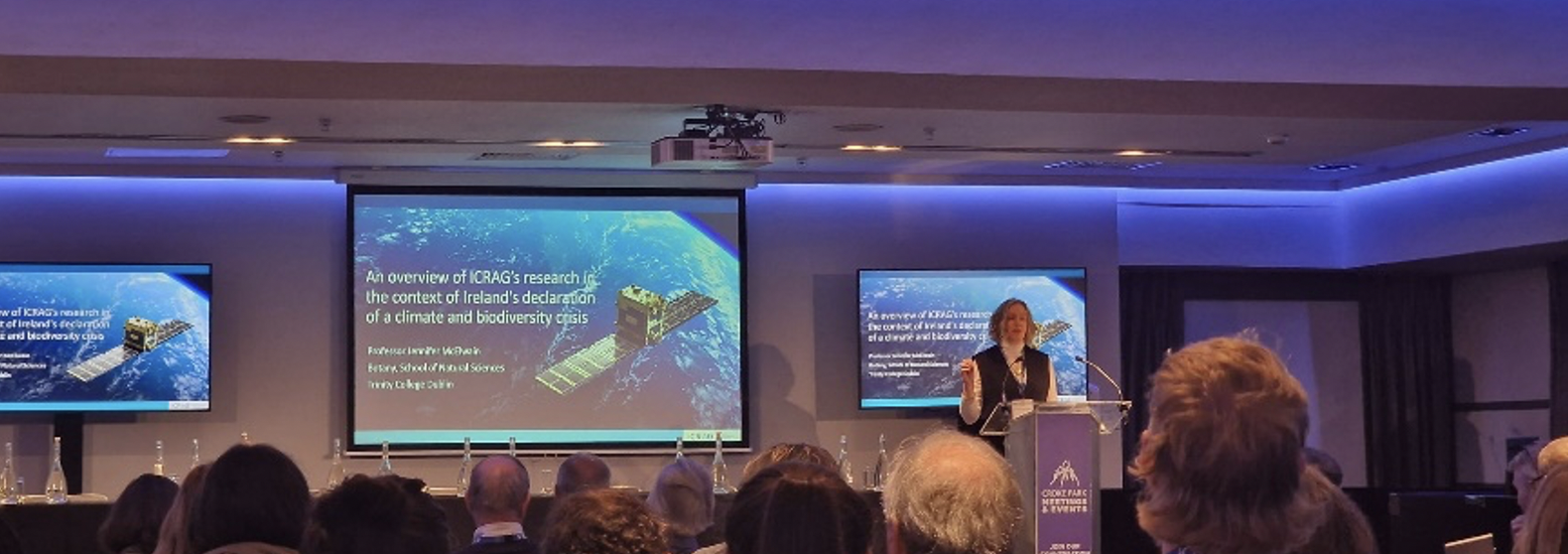
Professor Jennifer McElwain and Dr Sate Ahmad presented at the iCRAG Conference 2022 on the 1st of December 2022 at Croke Park, Dublin. Professor McElwain gave an overview of research under the Earth System Change pillar of the Irish Centre for Research in Applied Geosciences (iCRAG) in the context of Ireland’s declaration of a climate and biodiversity crisis. Dr Ahmad talked about how elevated CO2 in the future may change ecohydrological response through changes in plant physiology. In total, 200 participants attended the event, several of whom were from the Botany Department.


EPA 5YAR Synthesis Report meeting
The Synthesis Report meeting for the EPA Five Year Assessment Report was held on 7th and 8th of November at FSTEM TCD. Authors from all four volumes on Ireland’s first climate assessment review were able to meet in-person and online. The aim of this meeting was to decide on the scope and outline of this important stage of the process, which follows a similar format to the IPCC.
The Synthesis Report will provide an integrated overview of the key messages from all four volumes of 5YAR, and aims to provide information for the policy guidance needed as a long term assessment strategy for Ireland and climate change. It was a great meeting and great progress was made collectively on this task.
More information on the 5YAR and the volumes provided within
https://www.epa.ie/our-services/monitoring--assessment/climate-change/5-yar/